Choosing a nursing home is one of the biggest decisions a family makes. A facility that looks great in photos can feel very different in person, and small signs during a visit often predict how your relative will live six months in. This guide cuts past the marketing to what actually matters.
On this page
The 7 Steps
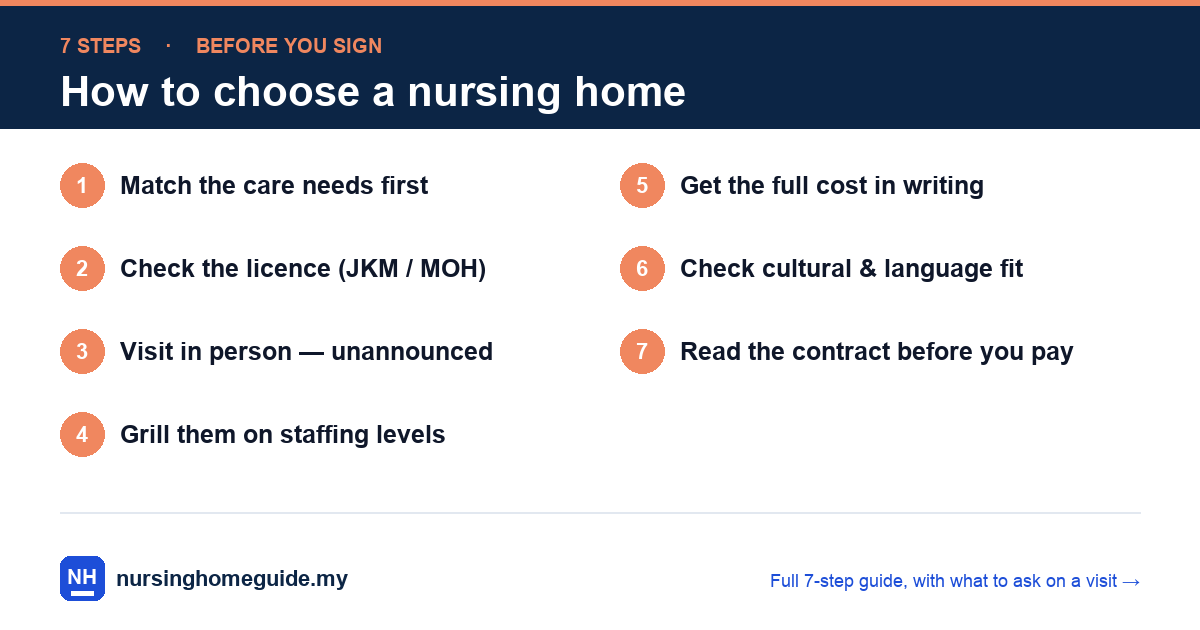
Start with your relative's care needs, not the facility
The most common mistake is picking a facility and hoping it fits. Reverse it: figure out what level of care is needed — basic supervision, skilled nursing, dementia, or post-op rehab — first. That narrows the search to facilities actually equipped for the job, not just willing to take the booking.
Use our Which Care? guide if you're not sure a nursing home is even the right setting.
Check licensing before anything else
Care centres should be registered with JKM under the Care Centres Act 1993 (Act 506). Facilities providing nursing care with trained nurses may also hold an MOH licence under Act 586. Ask to see the certificate before you tour.
An unlicensed facility has no regulatory oversight — your options are limited if something goes wrong. See our JKM licensing guide to verify.
Visit in person — unannounced if possible
A scheduled tour lets staff prepare. An unannounced drop-in during meals (12–1pm) or the morning routine (8–9am) shows you how it really runs. If the operator refuses unannounced visits, that's a red flag.
Trust your senses on the visit: What does it smell like? How do staff speak to residents? Are residents engaged, or sitting blankly in front of a TV?
Ask the hard questions about staffing
The nurse-to-resident ratio — day and night — is the single most important operational fact about a nursing home. No qualified nurse on the night shift means no safe response if a resident stops breathing or has a seizure at 3am.
Ask directly: "How many residents per nurse during the day? And at night?" Also ask what training non-nursing caregivers hold.
Get the full cost in writing
Verbal quotes often exclude diapers, physio, wound care, and medication handling. Ask for a written sheet showing inclusions and extras. This prevents disputes later and lets you compare facilities fairly.
See our nursing home cost guide for the extras to watch for.
Check cultural and language fit
An elder who can't talk to staff, eat familiar food, or practise their religion will decline faster than medical records predict. Cultural fit isn't a soft preference — it directly affects wellbeing and care compliance.
Confirm what languages staff speak, whether meals are halal-certified or culturally appropriate, and whether religious activities (Friday prayers, daily prayers, religious TV) are accommodated.
Read the contract before paying the deposit
Key terms to check: exit notice (30 days standard, some require 60–90), whether fees can rise mid-stay and with what notice, what happens to pre-paid months if the resident dies, and when the facility can discharge a resident involuntarily.
Never sign on the day of the first visit. Take the contract home, read it, ask questions.
References: Care Centres Act 1993 (Act 506) — JKM · Private Healthcare Facilities and Services Act 1998 (Act 586) — MOH
What to Look for on a Visit
- Staff greet residents by name and make eye contact
- Residents look clean, well-dressed, and engaged in conversation or activities
- Communal areas are clean and smell neutral (not bleach-masked)
- Staff can answer your questions without becoming defensive
- Menus are posted and meals look and smell appealing
- Outdoor space is accessible and used by residents
- Families of current residents seem comfortable and are visiting freely
- JKM or MOH certificate is displayed in the reception area
- Strong smell of urine or faeces in common areas (sign of understaffing)
- Residents who appear fearful or flinch when staff approach
- Staff cannot tell you the nurse-to-resident ratio
- No registered nurse on duty when you visit
- Pressure to sign or pay a deposit on the day of the first visit
- Refusal to permit unannounced visits once admitted
- No visible licence or registration certificate
- Facility is unwilling to provide a written cost breakdown
- Staff are visibly overwhelmed, rushing, or ignoring call bells
- Other families in the car park warn you off when you ask how it's been
Questions to Ask on Your Visit
| Question | Why it matters |
|---|---|
| What is the nurse-to-resident ratio — day shift and night shift? | Night safety depends entirely on having a qualified nurse present. 1:10 is considered a minimum safe ratio for a nursing home. |
| What qualifications do non-nursing caregivers hold? | Community care assistants (CCAs) should have at least a basic eldercare certificate. Unqualified helpers with no training are common in lower-tier facilities. |
| Are meals cooked fresh on-site, and can you accommodate dietary restrictions? | Pre-packed catering meals are cheaper but less nutritious and less culturally appropriate. Ask to see a week's menu. |
| Which hospital do you send residents to in an emergency, and how quickly can an ambulance arrive? | The answer reveals whether the facility has a reliable emergency protocol — or improvises every time. |
| Does a doctor visit the facility regularly, and how often? | A monthly or fortnightly GP visit for a review of all residents is a positive sign. "We send residents to a clinic" means no routine review. |
| Can I visit unannounced after admission? | Any facility that refuses unannounced family visits has something to hide. Visiting hours for strangers are fine; family visits should never require advance notice. |
| What is your policy when a resident's condition deteriorates? | You want to hear a clear protocol involving family notification, care review, and hospital referral — not vague reassurances. |
| What activities are available and how often are they held? | Social engagement is a genuine health intervention for elderly residents. A facility with no structured activities will accelerate cognitive decline. |
Cultural and Language Fit
Malaysia's three main ethnic communities each have distinct dietary, religious, and language needs. These aren't luxuries — they are basic dignities that shape daily life.
| Community | Key questions to ask |
|---|---|
| Malay / Muslim | Is the kitchen halal-certified or halal-compliant? Are prayer times accommodated? Is a prayer room (surau) available? Are female staff available to care for female Muslim residents? |
| Chinese | Do staff speak Mandarin, Cantonese, or Hokkien? Are Chinese dishes served? Are cultural festivals (CNY, Qingming) observed? Is a temple visit possible for mobile residents? |
| Indian / Tamil | Are Tamil-speaking staff available? Are vegetarian or South Indian meals served? Are Hindu or Christian religious needs accommodated? |
| All communities | Can a family member visit at any time without appointment? Is the chaplain or religious leader able to visit if requested? Are social activities culturally appropriate? |
Depression is a real risk after admission. Malaysian forum threads keep flagging it: "problems started months in" is a common theme. Moving from home to a care setting is a major life event. The two biggest things families can do: visit regularly, and pick a culturally matched facility.
References: Family experience patterns drawn from Malaysian eldercare threads on Lowyat.net
What to Check in the Contract
- → Exit notice period: How many days' notice is required to leave? 30 days is standard; 60–90 days is common at premium facilities.
- → Fee increase clause: How much notice does the facility give before raising monthly fees? Is there a cap?
- → Deposit refund: Is the security deposit refundable and under what conditions?
- → Prepaid months on death: If the resident passes away mid-month, are unused days refunded?
- → Involuntary discharge: Under what conditions can the facility ask you to leave? This is important for residents with complex behaviours (dementia, aggression).
- → Extras billing: Which services are included in the monthly fee and which are billed separately, and at what rates?
Frequently Asked Questions
Find facilities near you
Browse 350+ verified nursing homes across Malaysia — editorials, photos, and pricing where published.
Browse Nursing Homes →